Generating templates
Rest-frame templates
In this step (specifically, make_tmp_z0), gsf generates model spectral templates via python-fsps citep{foreman14}, based on the parameters in the configuration file. The parameters are limited from the original fsps citep{conroy09fsps}, such as the range in metallicity, initial mass function (IMF), and ionizing parameter.
It is in this step that generates templates with different ages and metallicities. The templates are saved in a common file, “spec_all.asdf” (irrespective to object IDs), for the aim of saving time. Redshifted templates (below), which are actually used in the fitting process, are based on this file. Therefore, if one wish to change any of template-critical parameters (IMF, age/metallicity range and step etc.), it is suggested to save the previous file to avoid overwriting, or move in another directory to avoid confusion.
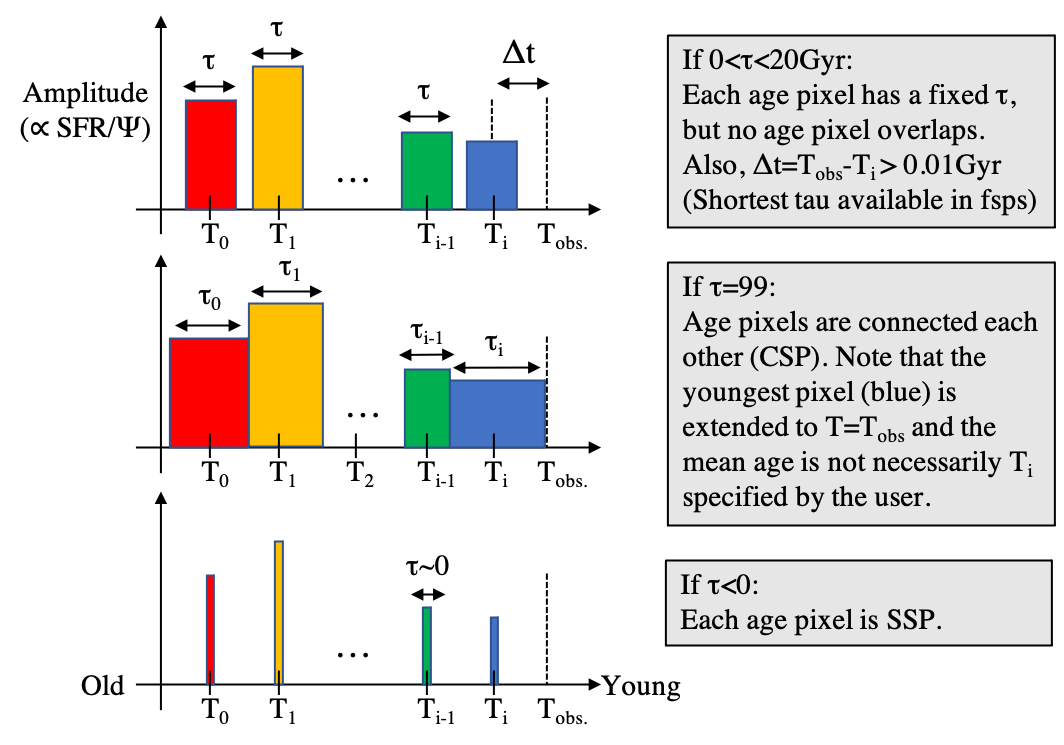
Age pixels determine the number of templates at different lookback times. The length of star formation is specified by a parameter, TAU0, in the configuration file. The length, if specified to a value <99, is uniform in all age pixels in the current version. If set to 99, then the CSP is applied so that age pixels are continuously connected each other. If set to a negative value, then SSP is applied.
Shifting templates to the input redshift
In this step (specifically, maketemp module), gsf shifts rest-frame templates generated above to the input redshift and extract expected fluxes for input filters for one-to-one comparison. Basically there are three steps;
- Redshift templates:
- Scaling flux:
where \(d_L\) is luminosity distance to the input redshift.
- IGM attenuation:
where gsf applies the Madau model for IGM attenuation at \(z>6\).
gsf will store the files generated here in a directory specified by DIR_TEMP.